
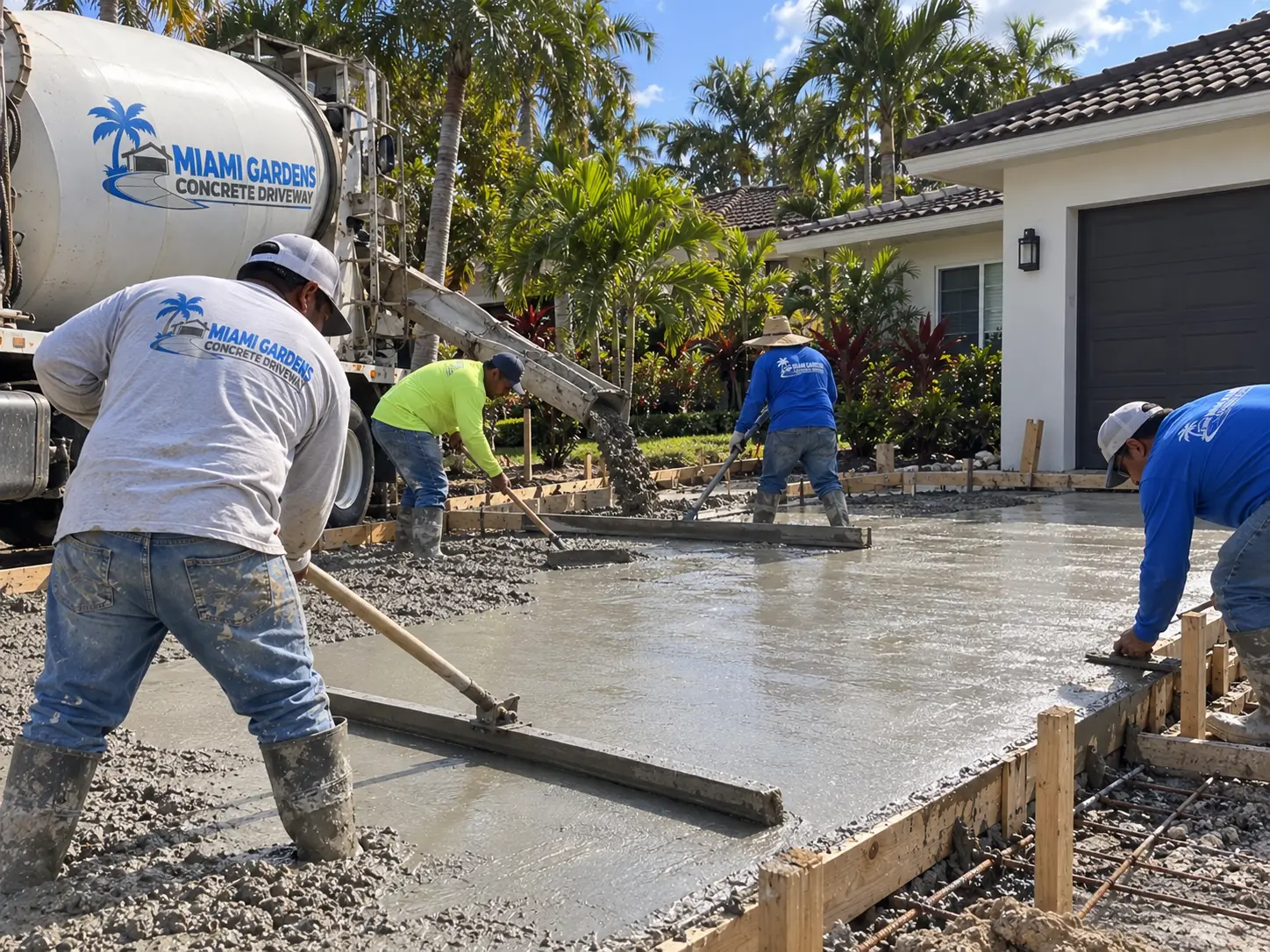
Apron versus driveway slab
Homeowners usually think of the driveway as one continuous surface. Functionally and administratively it is two things. The slab inside your property line is private-property concrete. The apron — also called the approach — spans from the edge of the roadway across the swale area to your property line, and it exists to carry vehicles off the public street onto private property without disrupting drainage along the right of way.
That difference in purpose shows up in the requirements. The city's published driveway guidance calls for a minimum of 4 inches of 3,000 PSI concrete with wire mesh or approved fiber reinforcement inside the property line, while the published approach guidance specifies a minimum of 6 inches of concrete. The thicker section reflects the loading it takes and the fact that it is part of the public interface, not just your parking.
Why aprons fail first
- Every vehicle entering or leaving loads it, often while turning, which grinds at the edges.
- Delivery trucks and service vehicles cross it even when they never enter the driveway.
- It sits at the lowest, wettest part of the driveway run, where base erosion is most likely.
- Older aprons were frequently poured thin and without reinforcement.
- It is the boundary between two independently settling areas — the road base and your yard.
The visible symptoms are a broken-down street edge, a crack running parallel to the property line, a dip that scrapes the underside of low vehicles, or a section that has dropped enough to hold water after rain.
What apron work involves
Assessment and requirement check
The first step is confirming what applies to your address. Approach work touches the right of way and the swale, so requirements and documentation are confirmed with the city before anything is cut. The permit guide explains what homeowners are usually asked for, including survey, application and impervious percentage information where applicable.
Removal and base correction
The failed section is saw-cut at a clean line, removed and hauled away. Base under an apron is usually the part that has eroded, so it gets rebuilt and compacted rather than topped up.
Forming to the correct profile
The approach has to transition smoothly from the street elevation to the driveway elevation without creating a scrape point or a dam that blocks swale drainage. Forming sets that profile, along with the flare width where vehicles turn in.
Reinforcement and a thicker pour
Reinforcement is placed and the section is poured to the published approach thickness, then finished with a texture that gives traction on a surface that is regularly wet.
Joints and curing
A joint separates the apron from the driveway slab and from any sidewalk, so the sections can move independently. Curing protection follows, and vehicle access across the apron is restricted until it is ready.
Local considerations
Miami Gardens streets rely heavily on swales for stormwater. An apron that has settled or been rebuilt at the wrong elevation can block that flow and push water where it should not go, which affects neighbors as well as your own yard. This is the main reason approach work gets scrutinized more than slab work, and the reason it is worth confirming the approved drainage plan first rather than after.
If the apron is failing and the rest of the driveway is also near the end of its life, doing both at once avoids paying twice for mobilization and gives you a single consistent surface — see driveway replacement. If only one interior section is damaged, repair is the narrower fix.
Apron cost factors
- Width of the approach and flare at the street.
- Thickness — the approach is a heavier pour than the driveway slab.
- Demolition of the existing approach and disposal.
- Base rebuilding where water has eroded material away.
- Sidewalk transition work, where a sidewalk crosses the driveway.
- Traffic control or access considerations on busier streets.
- Permit-related requirements and documentation.
The cost calculator includes an apron option so you can see its effect on the planning range, and the cost guide breaks down why apron pricing sits apart from per-square-foot slab pricing. Planning estimate only — not a quote.