
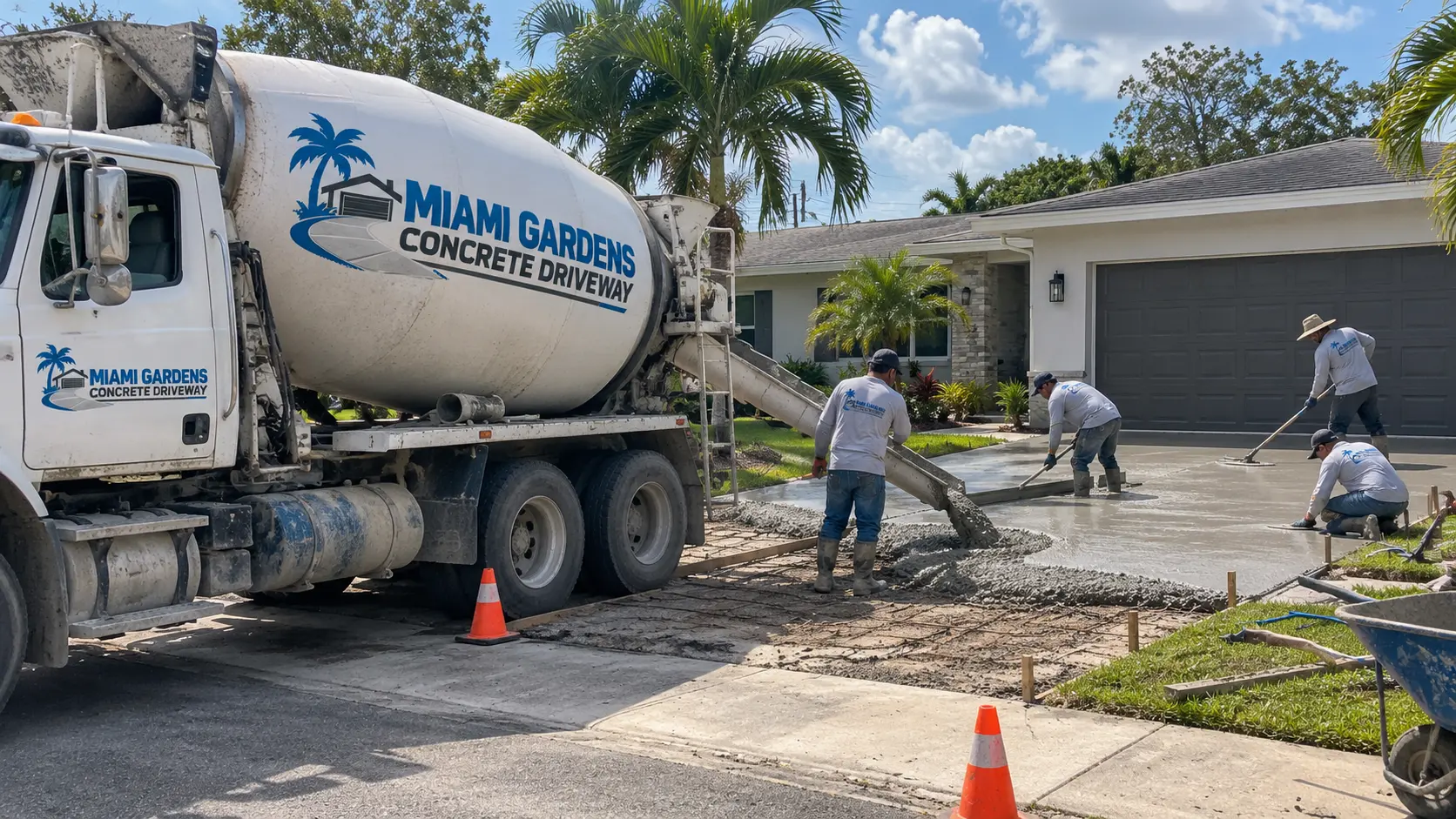
Why driveways get replaced rather than repaired
Most of the driveways replaced in Miami Gardens neighborhoods were not badly built for their time — they were built thin, on minimal base, with few or no control joints, and then asked to carry decades of vehicles through a climate that cycles between heavy rain and hard sun. Once several sections have settled, lifted or broken into crack networks, patching becomes a maintenance treadmill, because the problem is under the slab rather than in it.
Replacement is the only point in a driveway's life where the subgrade is accessible. That is the real value of the project: the soft spots get removed, the base gets compacted properly, the slope gets corrected, and joints get placed where they should have been. If you are still deciding, the repair or replace guide lays out the signals side by side, and repair remains the better answer when damage is isolated.
Signs a replacement is the reasonable call
- Multiple sections sitting at different heights, creating trip edges and tire slap.
- Crack networks across the slab rather than one or two straight cracks.
- Widespread surface scaling, crumbling edges or exposed aggregate from deterioration.
- Standing water on the driveway after normal rain, or runoff heading toward the house.
- A slab visibly thinner than current guidance, with no reinforcement and no joints.
- Repairs that have already been done two or three times in the same area.
The replacement process
Demolition and haul away
The existing slab is saw-cut at clean boundaries — typically at the garage, the sidewalk and the approach — then broken out and loaded. Reinforced older slabs take longer to remove. Debris is hauled off rather than buried on site, which matters because buried rubble is one of the causes of the settlement that ends driveways early.
Subgrade correction
With the slab gone, the soil underneath can be evaluated honestly. Soft or organic material comes out, the grade is reshaped to direct water where it should go, and the area is compacted. This is where a replacement becomes an improvement rather than a fresh coat of the same problem.
Base, forms and reinforcement
Compacted base is placed to depth, forms are set to the corrected elevations, and wire mesh, fiber or rebar is installed and supported within the slab per the plan and the city's published driveway guidance.
Pour, finish, joints and cure
Concrete is placed in a continuous sequence, screeded, floated and finished — broom texture by default, or a stamped or decorative finish if that is the direction you want. Control joints are placed at planned spacing, expansion joints separate the driveway from fixed structures, and the curing window is explained before the crew leaves.
Local considerations
A replacement is the right moment to solve a water problem that has been annoying you for years. If rain sheets toward the garage, if a low spot holds water for a day after a storm, or if the approach dumps water across the sidewalk, those are grade issues that can be built out of the new slab. Approach drainage is directed to the swale or approved drainage area, and the approach itself follows different requirements than the private-property slab — published approach guidance specifies a minimum of 6 inches of concrete versus a minimum of 4 inches inside the property line at 3,000 PSI.
Replacement scope frequently triggers the same permitting considerations as new work, including survey, application and impervious-percentage information, plus HOA awareness documentation where applicable. Confirm requirements for your specific property before work starts; the permit guide explains what homeowners are usually asked for.
What changes the replacement price
- Square footage, which drives both demolition and new pour cost.
- Thickness and reinforcement of the old slab — heavier old concrete is slower to remove.
- Disposal volume and haul distance.
- How much subgrade correction and base material the site needs once the slab is off.
- New slab thickness, reinforcement and finish.
- Whether the apron is replaced at the same time.
- Access constraints for demolition equipment and concrete delivery.
The cost calculator includes a removal option so you can see how demolition shifts the planning range. Planning estimate only — not a quote. Call for an exact price after a site visit.