
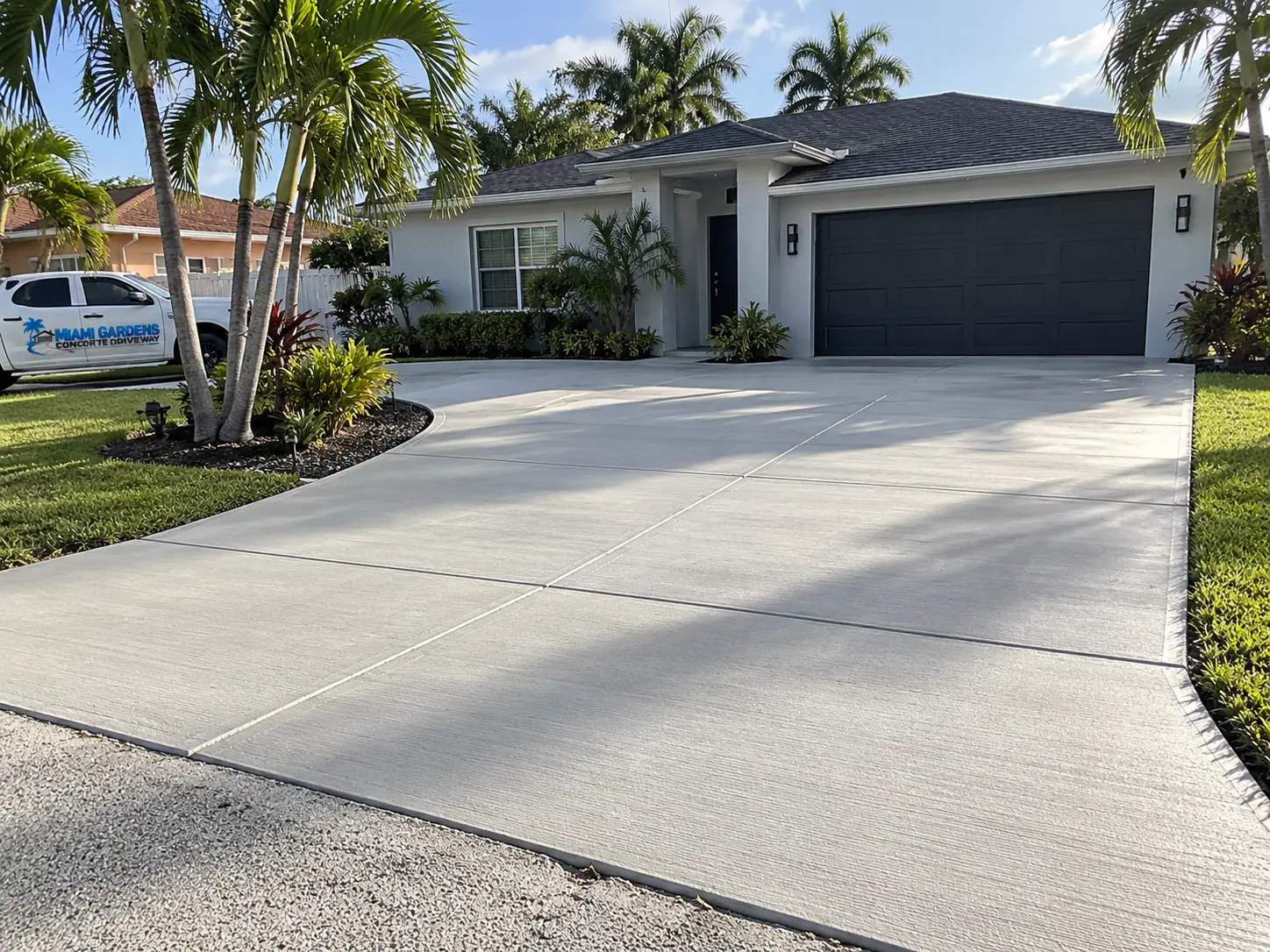
What decorative concrete adds
A driveway is often the largest single surface visible from the street. A standard broom finish is functional and does its job well, but decorative work gives you pattern, color and edge detail that ties the driveway to the roof tile, the pavers around the entry or the trim on the house. For homeowners already committed to a new pour, it is the point where a practical surface can also become a design element.
The options
Stamped patterns
Mats are pressed into the concrete while it is still plastic, leaving a texture and pattern — ashlar slate, cut stone, brick running bond, cobblestone and similar. Pattern scale matters on a driveway: large-format patterns tend to read better across a wide surface than small repeating ones.
Integral and broadcast color
Color can be mixed through the concrete or applied at the surface. Integral color is more uniform and ages more gracefully; surface-applied systems give richer, more varied tones but depend more on the sealer for longevity. Lighter tones stay noticeably cooler underfoot in South Florida sun than dark charcoal ones.
Borders and banding
A stamped or colored border around a broom-finished field is a common middle path. You get a defined, designed edge and keep the traction and lower upkeep of a standard finish across the area where the tires actually go.
Saw-cut and scored patterns
Cut lines in a grid or diamond layout give a clean, contemporary look without pattern mats. Since the cuts can coincide with control joints, this approach lets the necessary joint layout become part of the design rather than fighting it.
Traction, heat and upkeep in South Florida
Two local realities should shape the decision. First, rain: a driveway is a sloped surface that people walk on in wet weather, so a pattern that holds texture and a sealer with a non-slip additive matter more here than they would in a dry climate. Second, sun: UV exposure is what fades color and breaks down sealer, which is why resealing is a real maintenance item rather than an optional upsell. The finish comparison guide puts broom, smooth, stamped, colored and exposed aggregate side by side on exactly these points.
Process differences from a standard pour
Everything up to the pour is the same as a standard installation: grading, compacted base, forms, reinforcement per the city's published guidance of 4-inch minimum 3,000 PSI concrete with wire mesh or approved fiber inside the property line. What changes is the finishing window. Stamping has to happen within a specific plasticity range, which means more crew on site at the pour and less tolerance for delays. Color release, stamping, detailing, washing and sealing then follow across additional visits.
Joint placement needs planning up front so that control joints land on pattern lines instead of cutting through the middle of a stamped stone. That coordination is the difference between a decorative driveway that looks deliberate and one that looks interrupted.
Cost factors
- Pattern complexity and how many mats and detail passes are required.
- Single color versus multi-color or antiquing systems.
- Border and banding detail, which adds forming and finishing labor.
- Square footage and slab thickness.
- Sealer specification, including non-slip additive.
- Demolition of an existing slab if this is a replacement.
- Ongoing resealing, which should be budgeted as a maintenance cost.
The cost calculator lets you compare broom, decorative and stamped finishes on the same dimensions so the premium is visible before you commit. See the cost guide for the full picture. Planning estimate only — not a quote.